
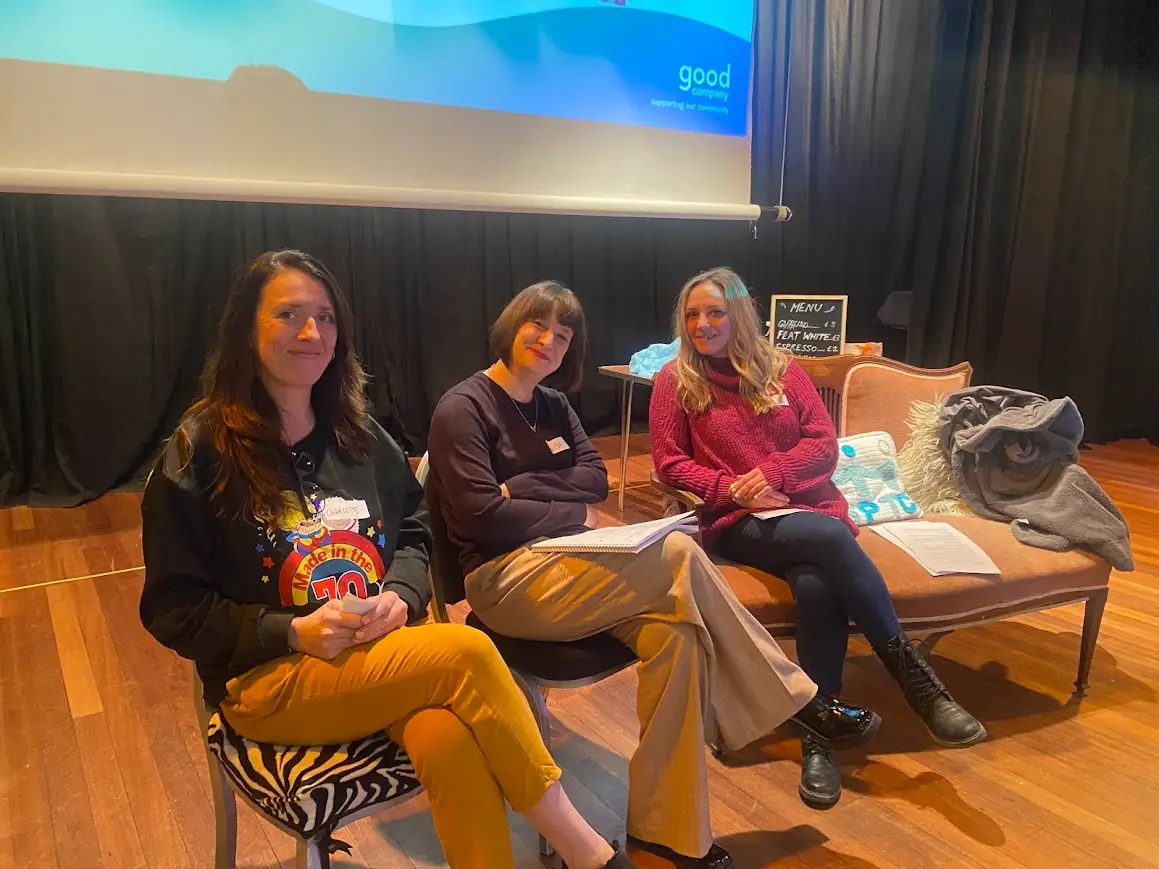
Charlotte (pictured above far left) was a community commissioner on the East Surrey Poverty Truth Commission and was part of the Domestic Abuse working group. In this blog, she talks about why the recommendation was made to deliver Health Relationships education in schools and her experiences of being trained as a facilitator and beginning to deliver the course in a local school.
There’s a lot in the news and online about violence against women and girls. A lot of people comment on arguments online and men say that women do it too. But really, the point is they should be teaching it in schools, addressing the problem before it arises.
On the Domestic Abuse working group, we couldn’t see any other option to help solve the issue of Domestic Abuse because there’s not a lot of work on solving the abusers, so it’s best to stop them before they perpetrate. I’ve always wondered what makes an abuser an abuser.
The Day Programme: Healthy Relationships Education
The Day Programme is a multimedia programme that uses short film, advertisements and chart music to raise awareness and provide education about domestic abuse and exploitation in a relevant and exciting way. It teaches that control and self-entitlement make an abuser. When you look at social media and songs that are influencing people, you can see how people can fall into that and have a relationship by controlling somebody.
Initially I had a video call with Natalie who built the Day Programme and Own My Life. The course is amazing, the way it’s managed and illustrated. She’s a survivor of Domestic Violence as well.
There were some difficult parts of doing the facilitator course. We were all together on a video call and we’d watch the videos, do quizzes and go into break-out rooms. It was really helpful and other people on the course included social workers and police officers. I was the only non-professional there. There was one video that upset me so much I couldn’t go into the break-out room. Some of it was triggering for me.
Natalie was very down to earth; you could tell that she really cares. You can tell she’s been through the cycle and out the other side, so it’s inspiring.
There are 10 sessions in total but we only delivered some of them [sessions 1, 8, 9 and 10]. Each session is an hour and we go over Biderman Behaviours. A doctor called Biderman realised in the 50s that domestic abusers had the same traits as soldiers who tortured prisoners of war. Isolation, humiliation, threats and fear are all part of Domestic Abuse.
I learnt about emotional maturity. When you’re young you think everything is about you and you think everybody is looking at you and judging you. It made total sense to me. You don’t realise that, until you grow up. So it reminded me of being that age and being really obsessed about how you look and what you’re wearing, which can make you vulnerable.
The school where we’ve begun to deliver the programme is great. The more that we’ve been there, the easier it’s been. I’ve been impressed with them as a school. I feel like the kids responded well, they were engaging and interested. I delivered it with a youth worker from Leatherhead Youth Project.
Being new to working in a school, I feel like I was observing and seeing how they reacted to it. I’m looking forward to seeing the evaluation forms from the kids.
I do feel like I’m contributing and trying to make kids understand the dangers and how to navigate. It’s sad really. Until society stops making it a thing, it’ll still be a thing so you’ve got to try and stop the normalising of Domestic Abuse. In fact, my perception is that boys are just as much at risk as girls now because of the internet and expectations put on them. What is normal now? I don’t know because what the kids are seeing on social media, it’s a minefield. There’s so much more influence than there was when I was young.
When I was young Domestic Abuse wasn’t illegal. It was only in the late 90s it became illegal. Now it’s the police that press charges. It’s very difficult for the victim to press charges, it’s not that easy, so convictions were rare. Now, police have bodycams and it’s not her word against his, it’s recorded. It’s important to teach young people about this.
What next….
I’d like to get into more high schools and make it national curriculum. I think the Day Programme should be part of the curriculum about sex and healthy relationships. Otherwise where do they get their information from, do they address it in this kind of format? It would be interesting to find out about their curriculum content.
I know Helen Maguire MP was in the Houses of Parliament talking about it. Maybe it would be good to show her the results of what the kids said. I don’t know the politics of it all.
Footnote:
Feedback from students so far is very positive, with 97% of participating students saying that the DAY programme course will help them to have better relationships, whilst 94% said they would know what to do if someone was abusive to them.
Click on the button below to choose a one off payment or a regular donation including gift aid where relevant.